Scientific ML: structured observations, training and model graphs
VAFT extends its existing ML lifecycle with mask-aware named observations, research training options and portable architecture graphs. The NeurIPS research adapter is a reference consumer; competition-specific models and physics stay outside VAFT core. No full challenge training is required.
Model computation and scientific meaning
A computational graph describes the supplied example execution. It carries shapes, dtypes, module hierarchy, parameter counts and extraction provenance. A static trace cannot prove behavior for arbitrary dynamic branches or shapes. FX is the default; an explicit export attempt can support additional operators. A failed attempt returns diagnostics rather than a misleading complete graph.

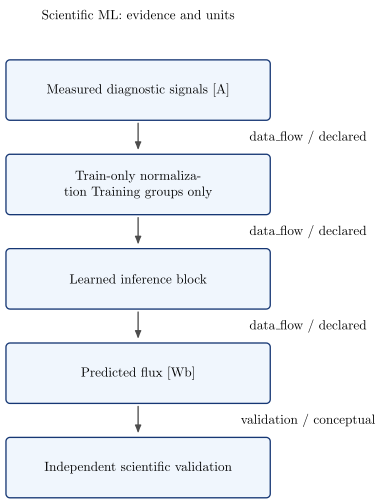
Scientific diagrams use VAFT’s existing renderer and typed coupling vocabulary. Executed, declared and conceptual relations are stated independently of model performance. Physical units and preprocessing conventions belong in the graph.
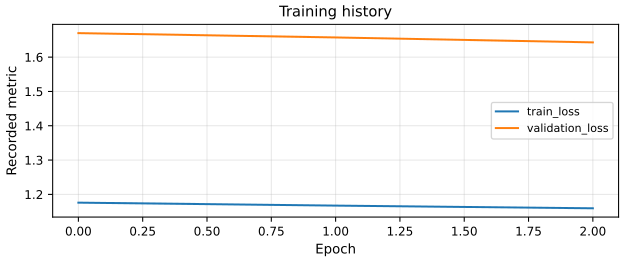
Training metrics
Loss histories, independent-group evaluation and measured resources adapt to
immutable vaft.plot.models.LineSeries. Plot renderers do not receive model
weights or a raw Torch module. Select related metrics with compatible units.
Structured source and checkpoint example
from vaft.process import ml

# source[i] returns StructuredSample(inputs, targets, target_masks).
data = ml.build_structured_dataset(
    source, groups, spec=ml.DatasetSpec(name="observations", task="regression"),
    input_specs={
        "tokens": ml.TensorSpec((None, 8), mask="valid", unit="[mixed declared features]"),
        "valid": ml.TensorSpec((None,), dtype="bool", normalize=False),
    },
    target_specs={"flux": ml.TensorSpec((17, 17), unit="[Wb/rad]")},
)
split = ml.split_groups(data)
# Register a task factory returning a module: named inputs -> named targets.
config = ml.TrainingConfig(
    optimizer="adamw", scheduler="onecycle", max_grad_norm=1.0,
    epochs=4, checkpoint_path="training.pt", max_epochs_this_run=2,
)
result = ml.train_model(data, split, registered_model_spec, config)
True means valid, including generated padding masks. Missing measurements are not physical zeros. Train-only moments exclude masked elements and validation samples. Target masks are separate from observation masks. Structured models use manifest schema 1; existing dense models keep schema 0 and their APIs.
Resume uses the same total epoch budget and rejects a changed model, dataset, split, normalization or training configuration. A warm-start loads only matching weights. Training checkpoints and published model artifacts remain distinct.
Qualified behavior and limits
Six NeurIPS network families passed small real DIII-D GPU checks (4/1/1 shots, 8 frames per shot, 17×17 grids, two epochs): PCA-MLP, CNN, FNO and Set PCA/current/current+PCA. MAST checks used label-free inputs only. FX succeeded for PCA-MLP/CNN/Set PCA; FNO/current decoders reported FX limitations and extracted through the explicit export path. AMP forward relative L2 was below 1% on the small fixture; this is functionality evidence, not a scientific performance or full-training memory claim.
JSON retains canonical local run provenance. A server-free MLflow PoC adds
optional querying; it is deferred as the default dependency. No raw data or
weights are uploaded by the tracking adapter. Model identity still belongs to
VAFT artifacts and vaft-nn.
Full consistency-proxy curricula, domain preprocessing/physical decoding and stochastic geometry subdivision stay in the research implementation. Structured ONNX export is unqualified; the native artifact remains available. GPU determinism is not guaranteed across devices or software revisions.
Reproduce the gallery with workflow/ml_research/qualify_tools.py; the offline
CPU notebook is notebooks/scientific_ml_lifecycle.ipynb. The capability audit,
source/fixture hashes, tool decision and GPU report are in workflow/ml_research/.