Computational layers
VAFT computes in three layers that are each useful on their own: Formula, Process and Code. An optional fourth notion, the Actor, is a contract for comparing several realizations of the same scientific operation. Most VAFT calculations do not need one. This page fixes the vocabulary (issue #1078, under the umbrella #1077) so that contributors put new work in the right place. How these layers fit with data, validation, orchestration and the other architecture views is mapped on Scientific architecture.
Independent of the physics. These layers say where a computation lives. What physical model it represents (MHD, drift kinetic, gyrokinetic, hybrid, orbit) is a separate classification, in Plasma models: a guide. A Code-layer adapter can run several models, and one model can appear in several layers.
Terminology
| Term | Meaning |
|---|---|
| Formula | An explicit mathematical relation or a compact analytic/semi-analytic kernel, used as a lower-level scientific building block (vaft.formula) |
| Process | A reusable VAFT-native scientific computation (vaft.process). Reduced, approximate, lightweight numerical, analytic-assisted and surrogate realizations belong here when they can reasonably live inside VAFT |
| Code | An adapter to an independent scientific code or solver package (vaft.code), typically for higher-fidelity or computationally advanced calculations |
| Actor | An optional, implementation-independent contract that groups several Process and/or Code realizations, only when they implement the same scientific operation |
| Implementation | One Process or Code realization that participates in an Actor |
| Run | One coherent, persistent simulation case (one simulation data dictionary) |
| Study | One reproducible scientific analysis over data, Runs, results, methods and selections |
There is no VAFT Workflow abstraction, and none is planned. The repository’s workflow/
directory holds concrete scripts, pipelines and studies (Pipelines);
it is not a public object model, and there is no vaft.workflow package.
How the layers relate
flowchart LR
  F[Formula] -->|may support| P[Process]
  P --> R[scientific data / result]
  C[Code] --> R
  subgraph optional[only for one scientific operation with several realizations]
    A[Actor contract]
  end
  P -.->|implementation| A
  C -.->|implementation| A
  A -.-> R2[comparable scientific result]
A direct call is the normal case: a Process or a Code produces its result without any Actor. An Actor is off the mandatory execution path. It becomes relevant only when several implementations genuinely perform the same operation and comparing or substituting them has concrete value.
Boundaries
Formula. A Formula is a lower-level relation that a Process may use. It is not normally an Actor implementation: the chain is Formula → Process implementation → scientific operation result.
Process. A Process may own several VAFT-native implementations of its computation: an analytic approximation, a reduced numerical model, a surrogate, an alternative lightweight algorithm. These are Process implementations, not Actors. Do not create an Actor merely to dispatch among implementations that already belong naturally to one Process API.
Code. Independent solvers stay under vaft.code (EFIT, CHEASE, TokaMaker, NICE, GPEC with DCON
and RDCON, NUBEAM, GACODE-family solvers; further codes join as they are integrated). A Code is usable on
its own and needs no Actor. Several Codes in one physics domain do not by themselves justify an
Actor; they can form one when they implement the same operation and a common contract makes
benchmarking or comparison meaningful.
Follow computational ownership, not prestige: a reduced or VAFT-native model is a Process even when a more advanced Code exists, and an external Code is not wrapped in an Actor merely because its capability can be named.
These boundaries say where code should live. To see which modules of each layer import which today, generated from the source, explore the current implementation in the VAFT dependency explorer.
When an Actor is justified
Create an Actor only when all of the following hold:
- a stable scientific operation can be stated independently of any one implementation;
- at least two real implementations perform that operation, whether they are Processes, Codes or a mixture;
- scientifically comparable inputs and outputs can be identified without erasing important differences;
- comparison, substitution, verification, validation or fidelity selection gains concrete value from the common contract.
Semantic discovery, GUI presentation or AI tooling alone are not reasons to create an Actor. If the contract becomes artificial or too lossy, keep the computation Process-centric or Code-centric.
Granularity. Broad physics domains (equilibrium, stability, transport, heating, 3-D physics) are too coarse to be Actors. An Actor names a concrete operation for which several realizations correspond. Method-level distinctions stay implementation metadata: energy-principle versus ballooning formulation, truncation or Monte-Carlo sensitivity, solver continuation, kinetic options, numerical resolution. VAFT does not aim at a detailed ontology of fusion calculations.
Example: equilibrium reconstruction
The canonical illustration is one operation with several realizations:
equilibrium_reconstruction (Actor) |
Layer | In VAFT today |
|---|---|---|
| reduced reconstruction | Process | not implemented |
| EFIT | Code | integrated (vaft.code.efit) |
| TokaMaker reconstruction | Code | the adapter covers free-boundary forward, time-evolution and stability solves; reconstruction mode is not wired |
| VFIT | Code | legacy MATLAB framework; not wired as an adapter (some VFIT constraint rules are ported into the EFIT k-file builder) |
| NICE | Code | adapter exists, experimental (vaft.code.nice); no VEST reference slice reconstructs yet |
The Actor would define only the scientifically defensible common contract. Each implementation keeps its own input requirements, configuration, native results, assumptions and validity, and any extra outputs the others cannot produce. These differences are not normalized away.
Actor, Run and Study
An Actor does not own persistence or scientific organization:
- an Actor is an optional contract over implementations of one operation;
- a Run is persistent simulation state;
- a Study is a reproducible analysis, comparison or interpretation.
A Run can be created or extended without any Actor, and a Study can compare Process-native and Code-native results without one. Actor provenance is attached only when an Actor contract is actually used or explicitly referenced.
Where this fits: ownership and maturation
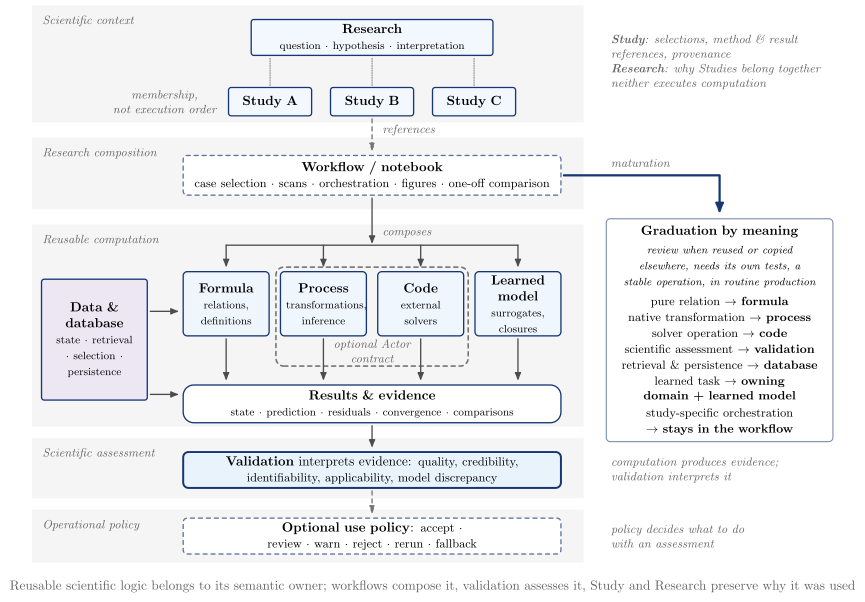
This page is the zoomed view of one band of a larger picture (#1645). That picture is drawn by
vaft.diagram.scientific_ownership_architecture() and described in
Diagrams. It separates five things:
- computational implementation: Formula, Process, Code and learned models, with data and the database, all producing results and evidence;
- validation, which interprets that evidence and is not part of the computation;
- use policy (accept, review, warn, reject, rerun, fallback), optional and downstream of validation;
- workflow maturation: a workflow or notebook composes computation and incubates new logic;
- Study and Research organization: a Study records one reproducible analysis, Research groups Studies by membership, and neither executes anything.
Logic leaves a workflow when it is reused or copied elsewhere, needs its own tests, defines a stable operation, or enters routine production (#1642). It is then promoted by what it means. A pure relation goes to Formula, a native transformation to Process and a solver operation to Code. A scientific assessment goes to validation, retrieval and persistence to the database, and a learned task to its owning domain with a learned implementation. Study-specific orchestration stays in the workflow.
Status
This page is the vocabulary only. No Actor protocol, implementation registry, scheduler, workflow
engine, persistence, or Run/Study API exists yet, and no existing Code adapter is being migrated.
The follow-up issues are #1079 (a minimal Actor protocol and implementation registry), #1080 (optional
shared inputs/outputs and the provenance, assumptions and validity metadata), and two prototypes
in scientifically different domains, #1081 (equilibrium_reconstruction) and #1082 (plasma_response).
Code-centric and Process-centric use stay normal and supported throughout.
This page says where a computation lives. What physical model it represents – which equations, which ordering, what “kinetic” means for it – is on Plasma models, orderings, and scales.