VAFT — Versatile Analytical Framework for Tokamak
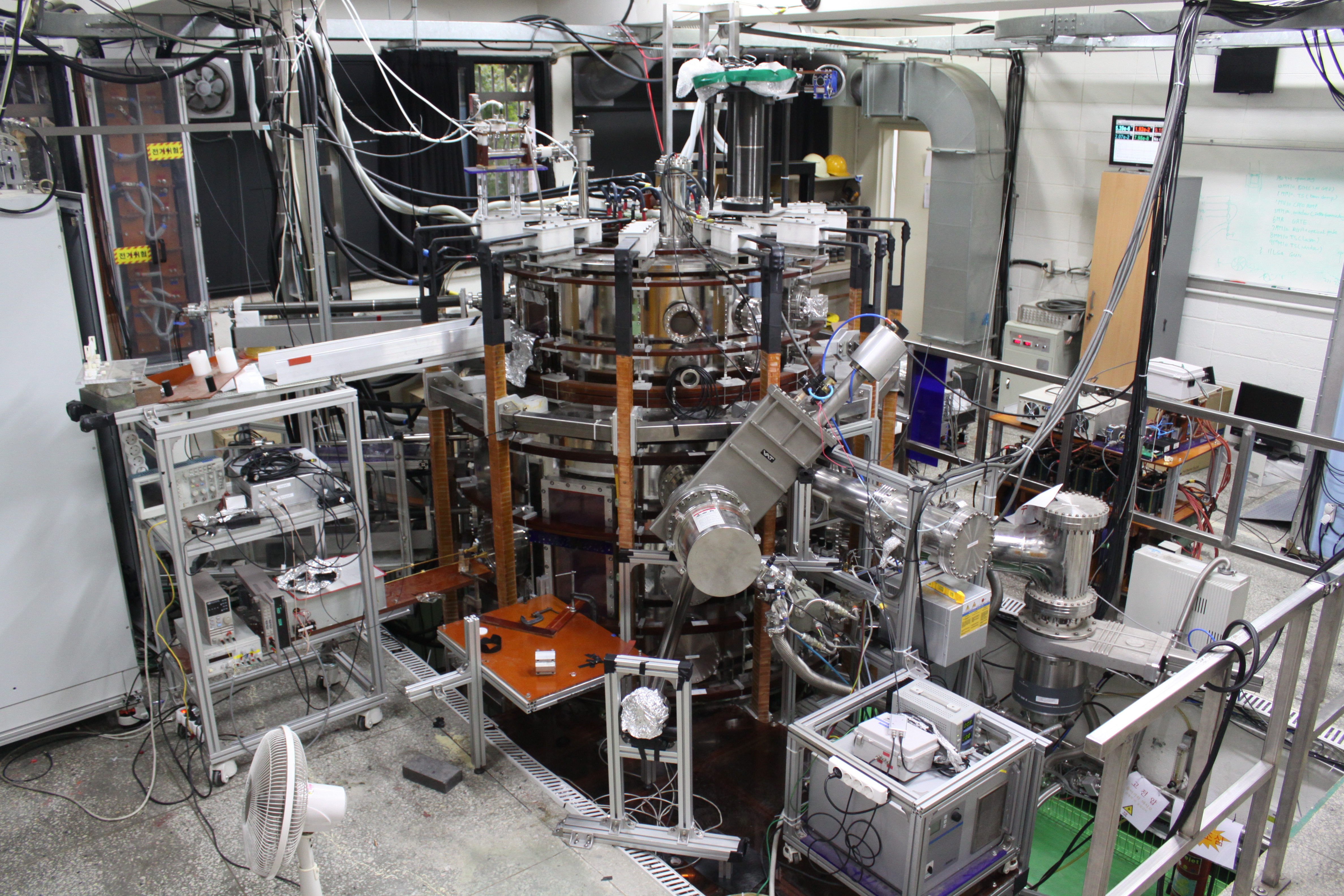
VAFT is an open-source Python library that functions both as a dedicated data platform for the VEST (Versatile Experiment Spherical Torus) tokamak at Seoul National University and as a machine- and code-generic data analysis framework built upon the IMAS data model. It provides an IMAS-compliant data interface built on the OMAS interface library and an HSDS remote HDF5 database. Read access to the VEST database is open to all users; writing to the database is restricted to authorized accounts.
Hong-Sik Yun, Sunjae Lee et al 2025 Plasma Phys. Control. Fusion 67 115021 — “Developing an IMAS-compatible platform for the university-scale tokamak VEST and its application to operating characteristics analysis” (doi:10.1088/1361-6587/ae1b6a)
Choose a path
Key features
| Capability | Description |
|---|---|
| Remote database access | Load per-shot OMAS ODS data from the VEST HSDS server with a single function call |
| Machine mapping | Convert native VEST diagnostic signals into standardized IMAS IDSs (magnetics, Thomson scattering, barometry, PF active, TF, spectrometer UV, charge exchange, etc.) |
| Equilibrium & stability | Interfaces for EFIT, CHEASE, GPEC (DCON/RDCON) — read/write code I/O in IDS format |
| Physics formulas | Equilibrium quantities (poloidal/toroidal flux, safety factor), stability metrics (beta limits, ballooning), confinement scaling laws (ITER89P, H98y2), Green’s functions |
| Signal processing | Smoothing, baseline subtraction, noise reduction, electromagnetic field calculations, eddy current modeling |
| Profile fitting | Map kinetic diagnostics (Thomson scattering, CES) onto equilibrium flux surfaces; fit with GP, polynomial, or exponential models |
| Visualization | Time traces, 1D/2D profiles, flux surface contours, top-view, and operational-space maps |
| IMAS interoperability | Convert between OMAS ODS and IMAS-Python (AL5) data structures; export to NetCDF |
Architecture
VEST Data Analysis Platform
├── Automated Pipeline (Snakemake)     ── experiment → postprocessing → simulation
├── IMAS Database (OMAS-HSDS)          ── per-shot HDF5 storage via REST API
└── VAFT Library                       ── data access, mapping, processing, visualization
Available IMAS IDSs in the VEST database
Experimental:
dataset_description · magnetics · tf · pf_active · barometry · spectrometer_uv ·
thomson_scattering · charge_exchange
Modelling:
wall · em_coupling · pf_passive · equilibrium (EFIT/CHEASE) · core_profiles ·
mhd_linear (DCON/RDCON)
Quick start
import vaft

ods = vaft.database.load(39915)     # OMAS ODS for one shot, from the public HSDS directory
ip = ods['magnetics.ip.0.data']     # IMAS-structured access
Install from source, add the HSDS client, then configure your connection:
git clone https://github.com/VEST-Tokamak/vaft.git
cd vaft
python -m pip install -e .
The source install includes h5pyd. Start with the packaged offline sample, then configure HSDS only
when you need public VEST data. See Start here for both paths.
Documentation
| Guide | Contents |
|---|---|
| Research workflows | Start with an offline result and continue through the VEST analysis chain |
| Data access and IMAS | Load, inspect, map and convert experimental data |
| Equilibrium and kinetic profiles | Reconstruct equilibria and fit diagnostic profiles |
| Automated pipelines | Snakemake routine, corrective and summary workflows |
| VAFT API | Module-by-module library reference |
| VEST diagnostics and data availability | Generated registry of data source, availability, lifecycle and VAFT mapping status |
| Notebooks | Runnable notebooks, design shells and verified outputs |
Resources
- Source: github.com/VEST-Tokamak/vaft
- OMAS: gafusion.github.io/omas — Python API for IMAS data structures
- OMFIT: omfit.io — integrated modeling and experimental data analysis framework
- HSDS: github.com/HDFGroup/hsds — HDF5 REST-based data service
- h5pyd: github.com/HDFGroup/h5pyd — Python client for HSDS
- IMAS: IMAS-Data-Dictionary — ITER Integrated Modelling & Analysis Suite
Contact and support
All users may read the VEST datasets, while shared-database writes require authorization. For maintenance, write access, technical-system routing, and issue reporting, use Contacts. For more about the laboratory and the VEST device, visit Nuplex.