VEST and tokamak physics background
VAFT — the Versatile Analytical Framework for Tokamak — is an open-source Python library developed by the VEST team at Seoul National University. It serves two purposes at once:
- a dedicated data platform for the VEST tokamak, and
- a machine- and code-generic data analysis framework built on the IMAS data model.
Everything the framework exposes — remote shot loading, diagnostic mapping, physics formulas, equilibrium and stability code interfaces, profile fitting and visualization — is organized around standard IMAS data structures, so an analysis written against VEST data is, in principle, portable to any IMAS-described machine.
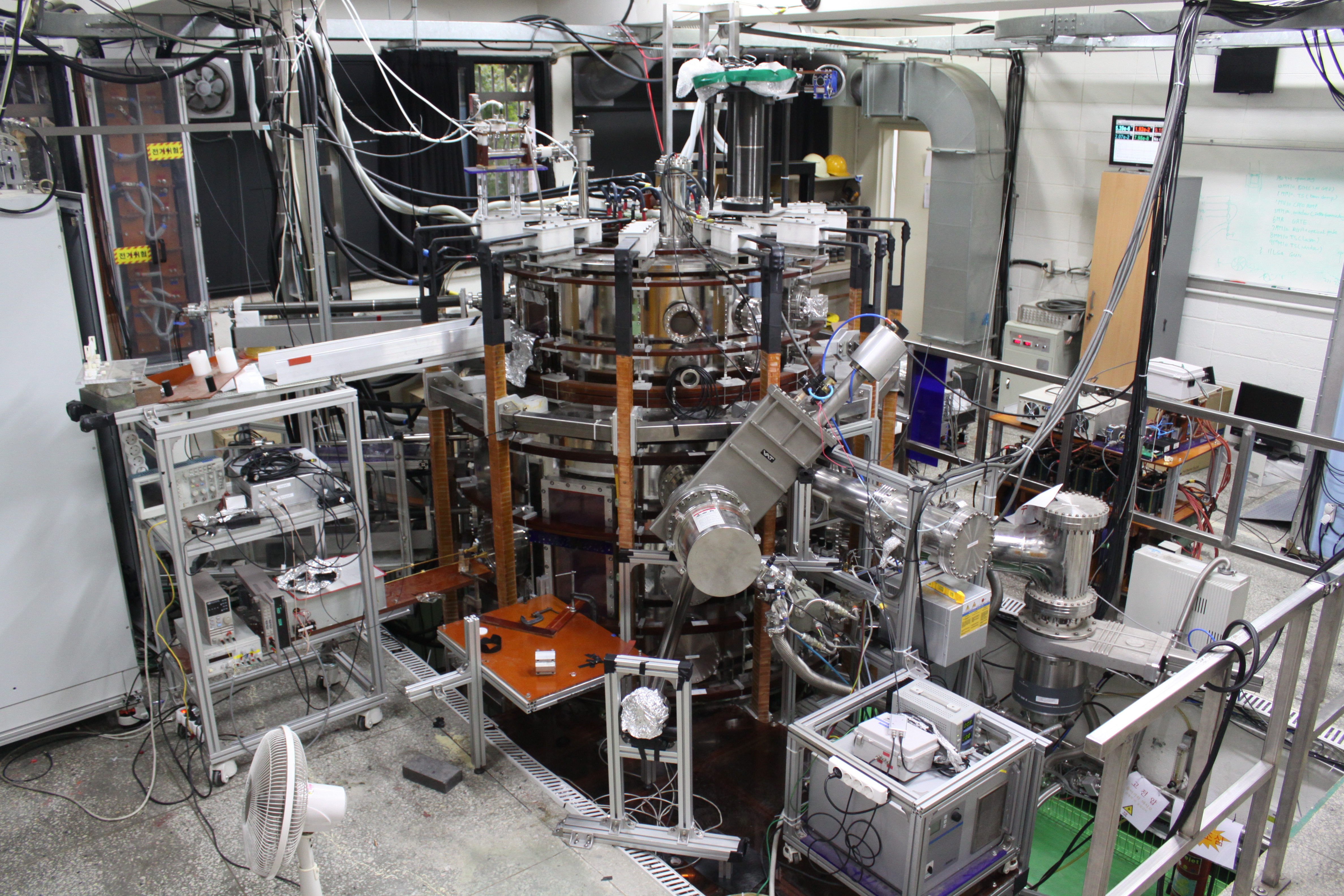
The VEST device
VEST (Versatile Experiment Spherical Torus) is a university-scale spherical torus operated at Seoul National University. Its experimental campaigns produce the shot database that VAFT reads, maps and post-processes: magnetics, TF and PF coil currents, barometry, UV spectrometry, Thomson scattering and charge exchange, together with the modelled quantities derived from them (wall and passive-structure models, equilibrium reconstructions, core profiles, linear MHD).
A per-shot walkthrough of the raw signals and their IMAS counterparts is in the Magnetics and Machine mapping guides.
Foundations: IMAS, OMAS and HSDS
VAFT does not invent a data model. It composes three existing ones:
| Layer | Role in VAFT |
|---|---|
| IMAS | The ITER Integrated Modelling & Analysis Suite data dictionary — the schema every VEST quantity is mapped into (magnetics, pf_active, equilibrium, core_profiles, …). |
| OMAS | The Python interface library. A VEST shot is handed to you as an OMAS ODS, so the whole OMAS/OMFIT ecosystem applies unchanged. |
| HSDS | The HDF5 REST service hosting the VEST database. Shots live as per-IDS HDF5 images on the server and are fetched over HTTP. |
In practice that means one call gets you a fully IMAS-structured shot:
import vaft

ods = vaft.database.load(39915)
time = ods['magnetics.time']
ip = ods['magnetics.ip.0.data']
See Quick start guide to configure the connection, and Database for the storage model behind it.
What the library contains
vaft/
├── database/          # Remote database access (HSDS, raw SQL)
├── machine_mapping/   # Native VEST signals → IMAS IDS conversion
├── formula/           # Physics formulas (equilibrium, stability, Green's functions)
├── process/           # Signal processing, EM modelling, profile fitting
├── plot/              # Visualization (time, 1D, 2D, top-view, analysis)
├── omas/              # ODS utilities (shot metadata, sample data)
├── imas/              # IMAS-Python (AL5) interoperability
├── code/              # Code interfaces (EFIT, CHEASE, GPEC, Snakemake)
└── data/              # Sample data, geometry assets, calibration tables
Around the library sits the wider VEST data analysis platform: an automated Snakemake pipeline carrying each shot from experiment through post-processing to simulation, and the IMAS database itself. Both are described in Pipelines; the per-module surface is catalogued in the API reference.
Citation
If VAFT or the VEST database contributes to your work, please cite:
H.-S. Yun, S. Lee et al, “Developing an IMAS-compatible platform for the university-scale tokamak VEST and its application to operating characteristics analysis”, Plasma Physics and Controlled Fusion 67 115021 (2025). doi:10.1088/1361-6587/ae1b6a
Acknowledgements
The authors would like to thank O Meneghini at Proxima Fusion and J McClenaghan at General Atomics, O Hoenen at ITER Organization for their technical advice. Some parts of the data processing were performed using the code API in the OMFIT integrated modeling framework.
This research was supported by the National Research Foundation of Korea (NRF) grant funded by the Korean Government (MSIT) (RS-2023-00281276, RS-202400409564, and RS-2025-02304810).
License
VAFT is distributed under the Apache License 2.0,
as declared by the package classifier (License :: OSI Approved :: Apache Software License) in
pyproject.toml.
Getting in touch
Read access to the VEST database is open to everyone; write access, bug reports and collaboration enquiries are covered on the Contact page.
- Source: github.com/VEST-Tokamak/vaft
- Example notebooks: Examples