Database and data sources
vaft.database is the I/O layer of VAFT. It has two independent back-ends, and knowing which one
you are talking to explains almost every argument on this page:
| Back-end | Module | What a shot looks like | What you get back |
|---|---|---|---|
| HSDS — remote IMAS HDF5 store | vaft.database.ods, vaft.database.ids, vaft.database.utils |
a folder hdf5://{directory}/{shot}/ holding master.h5 plus one <ids_name>.h5 per IDS |
an OMAS ODS, or a native IMAS IDSToplevel |
| Raw DAQ — VEST MySQL database | vaft.database.raw |
rows in shotDataWaveform_* addressed by integer field code |
(time, data) NumPy arrays |
flowchart LR
    HSDS[(VEST HSDS<br/>IMAS HDF5 images)]
    SQL[(VEST MySQL<br/>raw DAQ waveforms)]
    subgraph db["vaft.database"]
        ods["ods.load_ods / ods.save_ods"]
        ids["ids.load / ids.save"]
        raw["raw.load_raw"]
    end
    HSDS -->|hsget| ods
    HSDS -->|hsget| ids
    SQL -->|mysql-connector| raw
    ods --> ODS["omas.ODS"]
    ids --> IDS["imas IDSToplevel"]
    raw --> ARR["(time, data) ndarrays"]
The IMAS/ODS data model itself is described in Data structures; this page is about getting the data.
The flat namespace
vaft/__init__.py and vaft/database/__init__.py are both lazy. import vaft is enough — you never
need import vaft.database. The database package also resolves unknown attributes by scanning its
submodules in the order ods, ids, raw, utils, so helpers defined in raw.py or utils.py
are reachable flat:
import vaft

vaft.database.is_connect()          # defined in database/utils.py
vaft.database.exist_shot('public')  # defined in database/utils.py
vaft.database.load_raw(39915, 102)  # defined in database/raw.py
The supported high-level remote API is load, open, and save. The raw, filedb, ods,
ids, and utils modules remain available for specialized and compatibility workflows.
Connecting to HSDS
h5pyd is a declared VAFT dependency on develop; a normal pip install . installs the compatible
client and its hsconfigure command. Do not install a separately pinned --no-deps copy.
Then write your credentials with hsconfigure:
hsconfigure
| Field | Value |
|---|---|
| Server endpoint | http://147.46.36.244:5101 |
| Username / Password | reader / test (read-only public account) |
This writes ~/.hscfg; h5pyd also recognizes a project-local .hscfg. Never commit that file.
Check the connection from Python:
import vaft

vaft.database.is_connect()   # True when the HSDS server reports state == "READY"
Local OMAS and IMAS operations do not require HSDS at all; use vaft.omas.load/save or
vaft.imas.load/save for those paths. See Start here for
the full environment setup.
Listing shots
vaft.database.exist_shot()                       # numeric shot folders in /public/, newest first
vaft.database.exist_shot('public', shot=39915)   # True / False
vaft.database.exist_shot('public', sort=1)       # ascending
vaft.database.exist_shot(data_filter='ts')       # DataFrame of processed Thomson-scattering shots
Full signature:
exist_shot(username=None, shot=None, data_filter=None, sort=-1)
usernamedefaults to'public'. Any other folder name returns that folder’s raw listing.sortis1(ascending),-1(descending, the default) or0(unsorted).data_filter='ts'(also'thomson_scattering') ignoresusername/shotand returns apandas.DataFramewith columnsIndex, Shot Number, Last Processed, Status, read from the processed-shots filehdf5://public_omas/processed_shots.h5(exposed asvaft.database.utils.PROCESSED_H5_PATH). It returnsNonewhen nothing has been processed.- Shot folders come back as strings, not ints. A connection failure prints
Connection errorand returns[]/False.
Eager and lazy HSDS access
vaft.database.load materializes data before returning it. The default representation is an
OMAS ODS:
import vaft

ods = vaft.database.load(39915, source="public", paths="magnetics")

time = ods['magnetics.time']
ip = ods['magnetics.ip.0.data']
The current high-level signature is:
load(shot, source="public", *, representation="omas", paths=None,
     occurrence=None, imas_version=None, cache="auto", transport="auto")
Set representation="imas" for native IDS objects. OMAS paths may point at an IDS root or leaf;
native IMAS requests accept top-level IDS names only.
# Several shots at once -> list of ODS
ods_list = vaft.database.load([39915, 39916, 39917], paths="magnetics")

# Native IDS materialization
equilibrium = vaft.database.load(
    39915, representation="imas", paths="equilibrium"
)

# Lazy, read-only access: data is fetched only when a path is touched
with vaft.database.open(39915, source="public", paths="equilibrium") as remote:
    times = remote["equilibrium.time"]
open() returns a context-managed lazy OMAS or native-IMAS adapter and never exposes a write
operation. Lazy native IMAS access does not convert Data Dictionary versions; use eager load()
when conversion is required.
Local OMAS, IMAS, and FileDB paths
Local artifact I/O belongs to the representation modules:
import vaft

ods = vaft.omas.sample_ods()
vaft.omas.save(ods, "/tmp/shot.json.gz")
restored = vaft.omas.load("/tmp/shot.json.gz")

# Native IMAS AL5/URI targets use the corresponding bridge
vaft.imas.save(ods, "imas:hdf5?path=/tmp/imas-entry")
restored = vaft.imas.load("imas:hdf5?path=/tmp/imas-entry")
vaft.database.filedb.FileDB resolves canonical, OMAS-first archive locations without writing:
from vaft.database.filedb import FileDB

db = FileDB.from_config({"filedb": {"root": "/srv/vest.filedb"}})
path = db.path("omas", shot=39915)
Set VAFT_FILEDB_DIR when the configuration uses that environment reference. The audit helpers are
read-only and propose legacy-to-canonical mappings without moving data.
Saving to HSDS
save(data, shot, *, target="public", representation=None, occurrence=None,
     imas_version=None, derived_cache="auto")
# Remote writes are admin-restricted; ordinary documentation and analysis are read-only.
uri = vaft.database.save(ods, 39915, target="my-authorized-namespace")
target must be a bare HSDS namespace, never an hdf5:// URI. VAFT infers OMAS versus native IMAS
from the supplied object and rejects a conflicting explicit representation.
Native IMAS IDS objects
When you want an IDSToplevel from imas rather than an OMAS ODS, use the IDS pair. Native loading
requires the keyword ids_name= — that is what distinguishes it from a directory argument:
# Both forms are equivalent
eq = vaft.database.load(shot=2, ids_name="equilibrium", dd_version="3.41.0")
eq = vaft.database.load_ids(2, "equilibrium", dd_version="3.41.0")

# A list of IDS names returns a dict {name: ids}
idss = vaft.database.load_ids(2, ["equilibrium", "pf_active"])
ids.load(shot, ids_name, directory="public", occurrence=0, dd_version=None, local_dir=None)
ids.save(ids, shot, env="server", path=None, dd_version=None)
ids.load downloads master.h5 and every .h5 it externally links — IMAS-Core refuses to open a
data entry with a missing link, even when you ask for a single IDS — then opens the staging directory
with imas.DBEntry("imas:hdf5?path=…", "r") and returns dbentry.get(ids_name, occurrence).
Saving a native IDS goes through save_ids, not save:
uri = vaft.database.save_ids(eq, 2, env="server", dd_version="3.41.0")
# -> "hdf5://{username}/2/equilibrium.h5"
vaft.database.save/save_odshandle ODS only and have nodd_versionparameter; passing one raisesTypeError. Usesave_ids(orvaft.database.ids.save) for IDS objects.ids.savehas nodirectoryargument. The target folder is the logged-in HSDS username (remapped topublicwhen that username isadmin), and both{ids_name}.h5and the regeneratedmaster.h5are uploaded. The IDS file name comes from the IDS metadata name.env="local"writes to~/public/imasdb/VEST/3/{shot}/1by default.
Which load is which
| Call | Result |
|---|---|
vaft.database.load(39915) |
OMAS ODS |
vaft.database.load(39915, "public_omas") |
OMAS ODS from the public_omas folder |
vaft.database.load(2, ids_name="equilibrium") |
native IMAS IDS |
vaft.database.raw.load(39915, 102) |
(time, data) from the raw SQL database |
vaft.database.raw.load is a legacy alias for raw.vest_load living inside raw.py. It is a
different function from the package-level vaft.database.load; never write
vaft.database.load(shot, field) expecting a waveform.
Raw DAQ signals (MySQL)
Raw signals are addressed by an integer field code and returned as (time, data) NumPy arrays,
with time in seconds.
from vaft.database import raw

raw.setup_raw_db()   # interactive: prompts for hostname / username / password
raw.init_pool()      # build the MySQL connection pool

time, ip = raw.load_raw(39915, 102)      # field 102 = Plasma Current
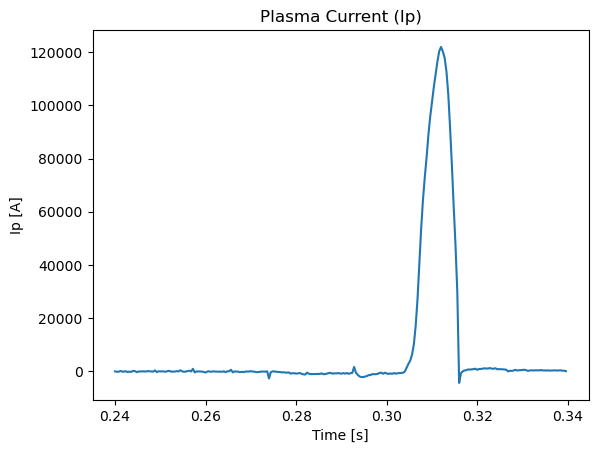
Credentials are stored in ~/.vest/database_raw_info.yaml with the password Fernet-encrypted using
~/.vest/encryption_key.key. setup_raw_db() uses input() prompts, so do not trigger it from an
unattended notebook — init_pool() and configuration() will call it if the YAML is missing.
load_raw initialises the pool automatically when it has not been built yet.
load_raw(shot, fields=None, max_retries=3, daq_type=None, sample_opt=False)
- A single
intfield returns a 1-D data array; alistof fields returns a 2-D array of shape(N, n_fields), column-stacked and truncated to the shortest field. load_rawnever raises — it logs and returnsNoneon any failure. Always check the result.
loaded = raw.load_raw(39915, [102, 101, 1])
if loaded is None:
    raise RuntimeError("raw load failed")
time, data = loaded
ip = data[:, 0]     # column order follows the requested field list
Finding field codes and shots
raw.name(102)                             # -> (field name, remark) from the shotDataField table
raw.vest_load_by_name(39915, "Plasma Current")   # load by human name (alias: raw.vest_loadn)
raw.get_all_field_codes_for_shot(39915)   # every field code recorded for the shot
raw.last_shot()                           # highest shot number in the database
raw.date_from_shot(39915)                 # ('YYYY-MM-DD', datetime)
raw.shots_from_date('2023-06-01')         # [shot, shot, ...]
raw.plot(39915, [102, 101])               # matplotlib quick-look
All of these need init_pool() first; they print an error and return None / [] otherwise.
vest_load_by_name resolves names through the packaged lookup table
vaft/data/legacy/sql_table.txt (a JSON mapping such as {"TF Current": 1, "Plasma Current": 102, …}),
also exposed as raw.SQL_TABLE_PATH:
import json
from vaft.database import raw

with open(raw.SQL_TABLE_PATH, "r", encoding="utf-8") as f:
    signal_to_field = json.load(f)
get_all_field_codes_for_shot omits raw.EXCLUDED_FIELD_CODES = {110, 111, 112, 113} (processed
triple-probe signals, which sit on a different time base).
Shot-range and timing rules
Which waveform table a shot lives in depends on its number, and load_raw returns None outside
these ranges:
| Shot range | Table |
|---|---|
29349 < shot <= 42190 |
shotDataWaveform_2 |
shot > 42190 |
shotDataWaveform_3 |
Sampling intervals are raw.FAST_DT = 4e-6 s and raw.SLOW_DT = 4e-5 s, classified against
raw.SLOW_DT_THRESHOLD = 5e-6 s. A DAQ trigger-delay correction is added to traces that start at the
digitiser origin: 0.24 s for shot < 41446, 0.26 s for shots 41446–41451, 0.24 s for 41452–41659, and
0.26 s from 41660 on.
Working offline
load_raw can read gzipped-JSON dumps instead of MySQL, which is how the test suite and the
processing pipelines run without database access. Two environment variables control it:
| Variable | Meaning |
|---|---|
VAFT_RAW_SAMPLE_PATH |
Path template for the archive; {shot} is substituted, e.g. vaft/data/legacy/shot_{shot}.json.gz |
VAFT_RAW_OFFLINE_ONLY |
1/true/yes/on forbids any live SQL access; load_raw returns None when no archive exists |
Resolution order inside load_raw is: an explicit sample_opt string → VAFT_RAW_SAMPLE_PATH →
(unless offline-only) the MySQL pool. raw.raw_offline_only() reports the current mode, and
raw.sql_loading_available() reports whether the MySQL driver imported at all.
import vaft
from vaft.database import raw

SAMPLE_PATH = vaft.data.data_path("legacy/shot_44740.json.gz")   # packaged archive

loaded = raw.load_raw(44740, 102, sample_opt=str(SAMPLE_PATH))
time, plasma_current = loaded
Produce your own archive for a shot with:
raw.init_pool()
raw.dump_all_raw_signals_for_shot(shot=44740, output_path="vest_raw_44740.json.gz")
dump_all_raw_signals_for_shot(shot, output_path=None, max_retries=3,
                              daq_type=0, slow_dt_threshold=5e-6, plot_opt=False)
It writes {"shot": n, "fields": {code: {"type": "fast" | "slow", "data": [...]}}} as gzipped JSON,
defaulting to ./vest_raw_{shot}.json.gz (a .gz suffix is appended if you omit it) and returning a
bool. plot_opt=True also saves an overview figure. raw.compare_db_and_dumped_raw_signals_for_shot
overlays the database and dumped traces for QA.
The pipeline scripts use exactly this pattern —
generate_raw_db_dump.py
creates the archive, and
generate_diagnostics_ods.py
sets VAFT_RAW_SAMPLE_PATH and VAFT_RAW_OFFLINE_ONLY before building the diagnostics ODS.
Where to go next
- Data structures — what is inside the ODS you just loaded.
- Signal processing and EM modeling — turning raw signals into physics quantities.
- Examples — the notebook tour.
Notebooks
database_initialization_and_load.ipynb— connect, list, load and save shots.vest_raw_signal_sql_database.ipynb— raw SQL signals and the offline archive path.vest_experimental_data_list.ipynb— surveying what exists in the database.
Source